
ESG
ESG

01 Challenges that are changing the business world
Global warming leads to many changes. Many things that were once explainable are now inexplicable. The world is weakening, the economy is slowing down, there are crises on top of crises, severe social problems, and governance is distorted.
- Climate change may cause challenges for the private sector in doing business and supply chains.
- Technological disruption may disrupt traditional business models and make some industries obsolete.
- Global economic volatility may affect the financial stability of organizations and the ability to operate efficiently.
- Political uncertainty, changes in government policies and regulations may affect the operations and profits of organizations.
ESG is the survival of businesses because it is a management framework used to drive businesses to grow sustainably. ESG takes into account 3 main factors:
- Environmental: Environmental management, efficient use of resources, and preserving the natural environment affected by business operations.
- Social: Social management, fair and equal management of human resources, from employees, customers, communities, and those working throughout the supply chain.
- Governance: Governance management, having a good corporate governance policy, conducting business transparently and fairly, resisting corruption, and looking after the interests of stakeholders.
Integrating ESG factors into business operations not only leads to reduced environmental impacts, better social responsibility, and better corporate governance. But also increase the financial efficiency and long-term value of the company.
Currently, investors around the world use ESG to consider investing in order to assess the sustainability and long-term competitiveness of the company. ESG is the new rule of doing business, and many countries have started to set ESG as a standard and practice in their operations.
For example, the establishment of the UK Stewardship Code, which requires institutional investors to disclose the use of ESG in making investment decisions. Later, the Stewardship Code became a model that many countries have referenced, including Japan, Malaysia, and South Africa.
At the same time, from the consumer perspective, the market demand has also become more focused on ESG, as people have become more aware of the social and environmental impacts of their purchasing decisions. A McKinsey survey last year found that 37 percent of European consumers care deeply about sustainability. They are willing to pay more for products that emit less carbon and are produced with care for the environment.
02 The value and worth of ESG
How good are ESG investments? This is a big question on the minds of investors and business leaders alike.
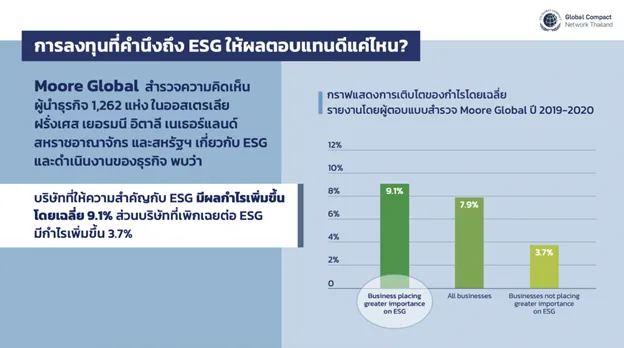
Moore Global surveyed 1,262 business leaders in Australia, France, Germany, Italy, the Netherlands, the UK and the US about ESG and how their businesses are performing. It found that between 2019 and 2020, during the COVID-19 pandemic, companies that prioritized ESG saw an average profit increase of 9.1 percent, while companies that ignored ESG saw a 3.7 percent profit increase.
80 percent of business leaders said ESG has become more important over the past three years, with COVID-19 being the biggest catalyst for change.
According to MSCI ESG Research, an agency with expertise and credibility in international ESG indices, the assessment of companies’ ability to manage social, environmental and governance risks results in the MSCI ESG Rating score.
Companies that are assessed as Leaders significantly outperform companies in the Average and Laggard levels. In Thailand, Bangchak is the only company to receive the MSCI ESG Rating at AA (Leader), the highest level for Thai companies in the same business group.
In addition, the data also indicates that companies that conduct business with a comprehensive consideration of all three dimensions of ESG have higher returns than companies that consider only E, S or G.
Although the value of investment in assets that focus on ESG in Thailand is still lower than in Europe, Australia and North America, it is growing steadily. In the past, Thailand has only just begun to move forward with ESG operations and has mostly focused on the environmental (E) dimension rather than the social (S) dimension, which is no less important.
Earlier this year, the UN Global Compact and technology consultancy Accenture released the CEO Study, a survey of global business leaders’ opinions on sustainability. Comprised of more than 2,600 CEOs and business owners from 18 industries in 128 countries, the report highlights the rise of social governance (S) in ESG, which is now defining a new role for businesses around the world.
91 percent of business leaders who took part believe their role is to protect local communities in the regions where their companies operate, which can straddle the lines between public and private sector responsibilities.
“The role of a CEO is no longer just about achieving the company’s goals and activities, but also about making a positive contribution to the wider community at the local, national and global levels,” said Lara Olsen, Managing Director of South East Water, a water supplier.
03 ESG Embedded in Business Processes
While they are both social and environmental actions, the essence of ESG is very different from the CSR (Corporate Social Responsibility) that Thai companies are so familiar with.
CSR is social and environmental responsibility reflected through non-profit activities outside of the core business. It depends on which aspect of society the organization wants to develop. It is different from ESG, which is a management framework that will be embedded in the concept and methods of doing business, including the business model of that organization.
For example, Patagonia, an outdoor clothing and equipment company that is very famous for integrating ESG into various business processes.
- Environmental Investing in renewable energy, offsetting emissions, promoting recycling by using recycled materials from the company’s products, and offering repair services to extend the life of the clothes.
- Social Collaborating with suppliers to create ethical and safety standards, promoting Diversity and Inclusion, creating a wide Outdoor Community.
- Governance Actively engaging with stakeholders, openly sharing progress in sustainability implementation.
Or in Thailand, Diamond Tile Company (DRT) has adjusted its production process by taking dust, which is a waste from tile production, and compressing and reshaping it into caterpillar bricks, increasing revenue by 4 million baht, including using waste paper to be pulped, which reduces costs by 25 million baht per year.
For business leaders, the question of ESG today is no longer What & Why, but How & When, because the challenge is not to create awareness, but to accelerate action to race against time. Every day, ESG regulations are changing or increasing. Those who understand and act to address and seize new ESG opportunities first will have an advantage in the marketplace.
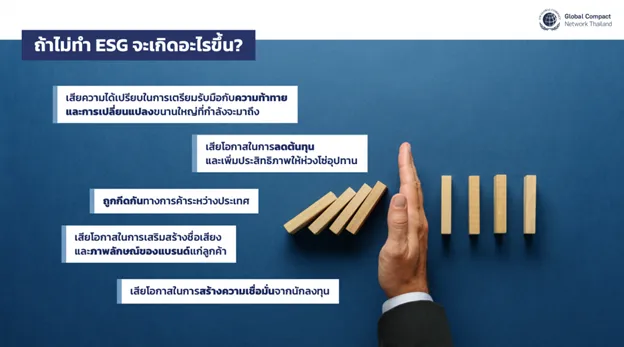
Delaying or avoiding ESG initiatives will only cost organizations opportunities and advantages, whether in terms of reducing costs and increasing efficiency in the supply chain, or preparing for upcoming challenges and major changes.
In addition, companies are at risk of being blocked from international trade, losing the opportunity to build trust with investors, and losing the opportunity to enhance the brand’s reputation and image with consumers, as has happened in the past.
- Environmental The oil spill incident in the ocean of a company caused damages of 620 billion baht.
- Social A commercial by fashion brand H&M presented a rather racist viewpoint, causing the loss of 290 billion baht in stock value.
- Governance
- Technology company Meta, the developer of the Facebook app, was fined 155 billion baht for data leakage.
- Airline company Boeing was sued for 6.6 billion baht in damages from the plane crashes in Indonesia and Ethiopia. The company’s board of directors was also sued in criminal cases.
04 Multi-Layer ESG Commitment
Business consulting firm McKinsey & Company offers ways for companies in different industries to start implementing ESG, even in different contexts. But what is the same is the “vision” of dealing with global challenges and changes. Currently, ESG practices can be grouped into 3 levels based on commitment and action.
Level 1 Minimum Practice Companies can start taking action immediately without high risk.
- Respond to trends that affect the business, such as switching to biodegradable product packaging, reducing energy consumption.
- Deal with external vulnerabilities such as the COVID-19 situation.
- Donate resources, both financial, goods, volunteers.
- Perform and report transparently according to standards.
- Make a commitment at the minimum commitment level.
Level 2 Common Practice Companies start to apply ESG in more parts of the business, but most of them are still outside the core business.
- Follow global trends that affect the business and prepare a backup plan.
- Create added value from the strengths of the business that are aligned with the ESG goals.
- Voluntarily comply with the requirements to meet the standards or higher than the industry average.
- Create a comprehensive sustainability policy.
- Perform HR activities that cover all groups of people.
- Operate charitable projects that have a high impact strategy.
- Engage with stakeholders to create a common understanding.
Level 3 Next Level Practice Companies embed ESG into their strategies. And fully integrated into business operations
- Use the company’s “superpowers” or expertise to drive ESG standards in its own industry
- Increase social impact through innovation, marketplace and customer choice
- Use ESG to create differentiation and use it as a core strategy of the organization
- Increase ESG into the organization’s capital and resource allocation
- Integrate ESG into work incentives and employee evaluations
- Improve sustainability results both internally and externally
- Ensure that ESG disclosure covers all operations of the company
One prominent Thai organization is SCG, which has been continuously doing this for a long time, is committed and has taken action on ESG in all 3 dimensions comprehensively
- Environmental
- SCG aims for Net Zero by 2050 by continuing to research and invest in Deep Technology such as electric vehicles, the use of artificial intelligence throughout the production process of products and services
- Create the SCG Green Choice standard, which is a label certifying environmentally friendly products and services Products that have passed this standard include SCG Solar Roof Solution and SCG Green Polymer.
- Social
- SCG has been developing vocational skills for SMEs, with a goal of creating jobs for more than 20,000 people by 2025.
- Developed the Q-Chang platform as a channel for consumers to search for SME technicians.
- Governance
- Created the “SCG Chemicals Code of Conduct” as a guide for employees at all levels in the organization.
- Employees at all levels must pass the “Ethics e-Testing and e-Policy e-Testing” tests, and have an ethics consultation system for employees called the GRC Helpline.
05 How can ESG really happen?
McKinsey & Company stated that advancing ESG requires considering the needs of stakeholders and society more broadly. In addition, there are external impacts, such as the spread of COVID-19 or unrest in various areas, which make ESG implementation more challenging.
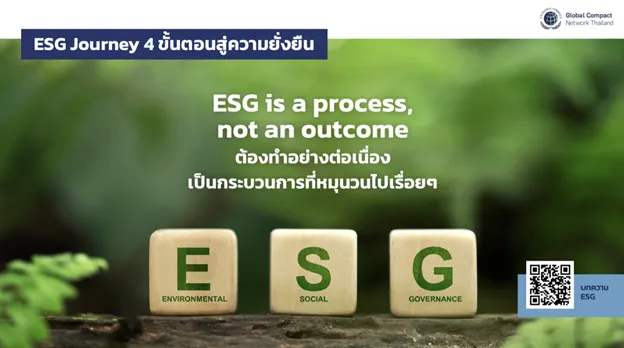
However, companies should focus on the ESG process rather than just looking at the results that will occur. There are 4 steps in practice that companies can use as a guideline for their ESG operations.
Step 1: Mapping
- Consider what your organization’s stakeholders are.
- Identify your organization’s strengths and weaknesses.
- Constantly and carefully compare your operations, products and services to those of other organizations.
Step 2: Defining
- Choose whether to do a High Jump or a Long Jump.
- Walmart has a strong supplier network and aims to do this throughout its long-term supply chain as a Long Jump.
- Think systematically about what the organization will gain or lose (trade-offs) by doing ESG.
- Measure and evaluate results as efficiently and quickly as possible. Focus on meaningful KPIs
Step 3 Embed ESG
- Integrate ESG into your organization’s operations through the 5 Ps that can be applied:
- Portfolio Strategy and Product: Integrate into investment and manufacturing strategies
- People and Culture: Integrate ESG into people and organizational culture
- Processes and Systems: Integrate into processes and systems
- Performance Metrics: Integrate into performance measurement
- Positions and Engagement: Integrate into positioning and engagement
- Monitor progress to ensure impact
- Identify which metrics or rankings are ESG-related and which are not
Step 4: Engage
- Communicate ESG actions to improve business strategy
- Dick’s Sporting Goods discontinued firearms sales in 2018, resulting in a decline in sales and stock price. However, the company continues to openly engage with consumers, employees, and investors, staying true to its purpose. Revenue and share value have since returned and are higher than ever
- Communicate with investors about the ESG plans for the business
- Communicate ESG at the right time and consistently
- When ESG is at the heart of the business model, if you are slow to report ESG performance, it may be interpreted that you are not committed enough.
Finally, business leaders are the heart of the organization and should have a passion for ESG because it reflects the culture and performance measures. There must be clear goals and communication in both words and actions.
“Leaders need to reset their perspectives, including resetting their imagination and design. This means thinking of new ways to do that process, to create products or processes that have never been done before. Importantly, leaders must create this culture in the organization.”